Average Reviews:

(More customer reviews)I originally did extensive research on the "vertical palm size" mini-DV camcorders and narrowed my decision down to the Sony DCR-PC9, the Canon Elura 20MC and the JVC GR-DVM75.Let me tell you that this was an extremely difficult evaluation because all three cameras have their strengths and weaknesses and there was no clear choice.The digital video technology found in all three of these compact cameras is absolutely amazing.I originally purchased the JVC but I had concern with the workmanship and the quality of the hardware - I had read several reviews where the owner eventually experienced problems and the cost to service the camera was extremely steep. I ended up buying the Canon Elura 20MC and did a side by side comparison against the JVC.Not being completely satisfied with either camera, I finally purchased the Sony camera as well.This ended up being an involved process but it was the only way to really evaluate the cameras.
Although you can make arguments that one camera had slightly sharper images or another one handled colors slightly better, overall all three cameras produced crisp, accurately colored images in outdoor sunlight settings.Under outdoor overcast conditions, the colors can be on the dull side but the video still was of decent quality. All three camcorders performed poorly under low light conditions. The low light video taping was indoors at night with single or double lamp lighting with light bulbs between 60 and 100 watts. The Cannon Elura produced the poorest quality video (even with the low light setting) - very dark and grainy and the quality was actually poorer than an 8mm analog camcorder.The Sony and JVC with standard auto-shutter settings produced about the same level of video quality which was less grainy but still on the dark side.The lower shutter speed settings on the JVC and Sony improves the image but the video becomes very choppy.As stated in other reviews, the Sony Night Shot (IR based) feature is impressive and works relatively well under "no light" conditions but creates the greenish monotone image.I am not sure how much video I will actually keep with the Night Shot but it is fun to use.
Sound quality is good on all 3 cameras but I do agree with the other reviewers who have commented on the problems associated with having the microphone located on the top of the camera.All the camcorders pick up some motor noise but the noise seemed to be more prevalent on the Canon.I also thought the sound was a little muffled on the Canon when compared to the other two camcorders.The Canon and JVC have wind screen options but I found them to be of limited value.
Not surprisingly, the digital stills from all 3 cameras were extremely poor. Even with the XGA resolution and built-in flash, the JVC stills were only marginally better than that of the other cameras.The best field stills (captured from video) came from the Canon and then the JVC.If you want to produce "print quality" digital stills, my recommendation is to purchase a separate dedicated digital camera instead of spending extra money on a higher CCD count.
You can read about specific features and functions in other reviews for the 3 camcorders but here is a summary of my side by side comparison:
For the Canon Elura 20MC
Pros:Quality Video, Progressive Scan, extended Recording Modes, good ergonomics and design, well constructed, the smallest of the 3 camcorders, manual exposure and shutter speed settings
Cons:Poor low light quality, short battery life, too small for large hands, microphone picks up the most motor noise of the 3 cameras, poor stills, no software, requires a shoe for external microphone and head phone, no USB support
For the Sony DCR-PC9
Pros:Quality Video, NightShot, the most features/functions of the 3 cameras, battery life was about 30% better than the other camcorders, lens ring for manual focus
Cons:Construction feels cheap, Poor Ergonomics, poor stills, cumbersome menu system, uses Sony's proprietary memory stick, limited remote controller functions
For the JVC GR-DVM75
Pros: Quality Video, High Band Processor emulates progressive scan, Built In Flash, well designed remote controller, good number of features/settings
Cons: Construction feels cheap, Poor stills, short battery life, poor viewfinder resolution, requires a shoe for USB connection,
Here are a couple of general observations for purchasing a camcorder. Most sales people only know the specs of each camera but have limited (if any) "actual use" experience outside the store.The image quality on the LCD screen is not a good indicator of the actual quality of the recorded video - you really need to view the video image on a TV screen.Finally, you cannot fully assess the quality of a camcorder within the confines of a store.
Because I am planning to do quite a bit of indoor video taping I decided to keep the Sony.I really hated to give up the Canon progressive scan. I originally thought I would keep the Canon (see my review under Elura 20MC) but the poor quality video in low light eventually prompted me to evaluate the Sony.The bottom line is that each camcorder is an excellent product and the best camera for you is dependent on your needs.If you are on a budget, the JVC offers the best overall value, performance, features for your money.Although I only had limited, the hardware quality of the JVC seems to be on par with the Sony.If you are primarily video taping under good lighting conditions and want to capture stills from video, then I would recommend the Cannon.The Elura was also the most compact, most comfortable and best designed.If you need a camera with many digital effects, options and special functions and are video taping in low light/night conditions then I would purchase the Sony.Good luck!
Click Here to see more reviews about: Sony DCRPC9 MiniDV Handycam Camcorder
Product Description:
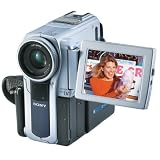
The Sony DCR-PC9 is a quality consumer-grade compact MiniDV digital camcorder. Packed with a 10x optical zoom and 120x digital zoom, the camcorder also features digital image stabilization. You can shoot and watch your video using either the color eye viewfinder or 2.5-inch LCD viewfinder. The unique vertical design makes it compact enough to hold within your hand without any strain.
Like most digital camcorders, the DCR-PC9 is equipped with an IEEE 1394 connection (also known as i.Link and Fire Wire) for digital image transfer, allowing video editing on a properly equipped home computer. In addition, all analog ports on the DCR-PC9 have analog to digital converters built in. With this feature, anyone upgrading from older analog equipment can transfer their old memory to new digital tapes.
If you own a TV equipped with Sony's Super LaserLink feature (or purchase an optional Super LaserLink attachment for your TV), playback is especially easy. You can just aim the DCR-PC9 at the TV from up to 26 feet away, press "play," and enjoy your videos without having to connect any wires.
The DCR-PC9 also doubles as a digital still camera, recording photos onto an included 4 MB Memory Stick at a resolution of up to 640 x 480 pixels. You can also record up to 60 seconds of video directly to the memory stick with the MPEG movie mode. Digital program editing allows for easy dubbing of 20 selected scenes from one digital camcorder to another, or to an analog VCR. Three different white-balance settings help optimize color. The DCR-PC9 includes a microphone input, as well as an accessory shoe for extra lights or microphones. Also included are an AC power adapter, lithium-ion battery, remote, stereo AV cable, lens cap, and lens hood.

Want to buy Sony DCRPC9 MiniDV Handycam Camcorder at other amazon sites? Click the corresponding icon below:


0 comments:
Post a Comment