Average Reviews:

(More customer reviews)First, let's describe what this is: it's a sound card. That means it offers analogue to digital and digital to analogue conversion on the device itself, and is capable of shuffling that data over a USB connection to your computer. It is _not_ a cable adaptor, which confused one previous reviewer; it is _not_ a "live" device - you can't use it as part of a studio monitor, which confused another. It is similarly _not_ a format converter. However, it _is_ useful for bringing in analogue sound to your Macintosh (or, in theory, PC).
The hardware itself is pretty impressive for the price, when dealing with line-level input. Drum captures are surprisingly crisp; piano capture is surprisingly lush; vocals are strong. It is _not_ professional equipment, but it's also not $300; the value for money is quite high. The input fidelity is significantly better than my Powerbook's onboard A/D converter, and the other, more expensive, card I have in our PC tower system.
On the downside, its analogue grounding and shielding is - perhaps unsurprisingly, given that it's a USB device - weak. In an RF-noisy area, you will probably pick up some noise that you won't hear on your stereo. I suspect this is where some complaints about hum have come from. I was able to create this problem at home, by playing with it. Insuring best possible ground connections on all other cabling, and adding some local shielding, can solve this problem if you live in an RF-noisy area. Similarly, turning off buzz-creating noise sources nearby - such as small motors, dimmer-switch controlled lighting, and so on - will help. This is not a disqualifying issue, but is one that should be taken into consideration.
On the other hand, the phono level pre-preamplification is simply poor - noisy and just kind of unpleasant - and the RIAA equalisation preset is iffy. If you want to use this device with a turntable, use your own first stage amplification to get it up to line level. (If you aren't in a band or an audiophile, what that means is: plug it into your stereo's "tape out" sockets instead of connecting your turntable directly to it.) Given that microphone input is similar, you'll probably want to use a powered microphone, or route your passive microphone through other equipment, before digitising.
As for the software: "Final vinyl" is mostly disappointing. As a data-capturing utility, it's adequate; the ability to set basic equalisation at capture time is useful and works well. It can be successfully used to extract individual tracks from a longer capture.
But as an editor, it is woefully inadequate. Even the simple track-creating task it was built for is laden with unpleasant surprises. Clearly, they did not throw significant testing resources at the software; it suffers badly from the "if you don't use it the exactly same way we use it, random things happen" problem often seen in products from smaller software houses.
_Many_ seemingly-reasonable actions put it into an unrecoverably discombobulated state. For example, trying to add a cue marker to the left of an existing cue marker confuses it irredeemably; you will probably end up with random cue mark placing, and when you try to start deleting cues, end up with a negative number of tracks. It is also easy to reorder random segments of sound in such a way that it does not, in fact, appear in the editor, but does appear in playback; I haven't found the pattern to that problem yet, but it is recurring and may involve selecting ranges for post-capture eq adjustment.
Most of these problems require you to revert to original capture data and flush the undo buffer, which means lost work. However, if you can figure out how _they_ use it, I suspect it works pretty well; but I shouldn't have to work constantly to figure out whether I'm going to trash all my work by moving a cue marker the wrong way, or whether trying to bring down levels at one point in a sample is going to reorder or copy other parts of the sample at random.
In summary: very good value for dollar hardware at line input level; less so for direct turntable input; and if you're thinking about buying it mostly for the software, get something else. I wanted it for the hardware, and as such, I'm pleased.
Click Here to see more reviews about: Griffin Technology iMic USB External Sound Card
Product Description:
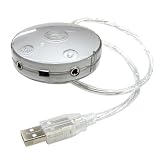
Audio connections are just a USB port awayThe iMic universal audio adapter is a USB device that adds a stereo input and output to your Mac or PC. This allows the connection of virtually any microphone or sound input device to a Mac or PC with a USB port. The iMic supports both line and Mic level input as well as line level output for any USB capable computer.By using USB, the iMic provides significantly superior audio input and output performance over built in audio. The iMic is a must have product for people who are serious about getting high quality audio in or out of their computers. iMicAudio input: 1/8" stereo line/mic-level minijack Audio output: 1/8" stereo line-level minijack System requirements: Mac: Mac OS 9.1 or greater, or OS X, USB port. PC: Win XP, USB port Works with most music & audio applications available Hardware control: toggle switch for mic/line setting Dimensions: .84"H x 2.5" Diameter Cable Length: 18" Manufacturer Warranty: 1 year

Want to buy Griffin Technology iMic USB External Sound Card at other amazon sites? Click the corresponding icon below:


0 comments:
Post a Comment