Average Reviews:

(More customer reviews)My HP Pavilion computer,(2003 vintage), came with a 17 inch CRT monitor. The monitor is superb and I have always been happy with it, but with only 15 inches of usable screen, I felt it was time to upgrade to a new and roomier LCD screen. After much research, principally at C-NET, I chose a Dell S2409W.
This monitor has a wide-screen 1920x1080 resolution. The problem is that my computers integrated graphics chips would not support this resolution. I could get a useful and distortion free display using my computers 1280x768 resolution setting, but this meant giving up a fair amount of available fine detail. Also, I have the CyberLink DVD suite which came with my DVD drive. This software has only a limited control over color saturation and balance (i.e. tint).
It occurred to me that a new graphics card might solve both problems. I might be able to use more of my monitors potential and get better control of color for my DVD viewing. I went with the EVGA card after careful thought. One worry is that my research showed that this card requires 10 amperes at 12 volts and an overall requirement of 350 watts in the power-supply. My computers anemic 250 watt supply seemed inadequate. However, I reasoned that since I am not a "gamer" and only intended to use my monitor for DVD videos and web browsing, I could get by with my more modest power-supply.
I installed the card and found that with some tinkering I could get my monitor to show it's best overall result at a resolution of 1600x900. The EVGA card includes Nvidia software which is right-click accessible at all times. The Nvidia software does provide more control over color, tint, and other parameters, but there is no control over horizontal height. This slightly annoys me because my Dell monitor in DVI, or digital mode, insists on showing a faint blue line along the bottom border of the screen. I don't believe this is a flaw, but a design idiosyncrasy, and the problem was present with my on-board graphics as well. I plan to visit the Dell site for a possible fix.
It occurs to me that with so many new wide-screen monitors arriving on the scene, it must be a fairly common problem getting 16/10 graphics to display properly. It should be noted that both my monitor and this card permit the full 1900x1080 display but I discovered that the text while sharp, is tiny and difficult to read. I feel strongly that most users will agree with me that the 1600x900 compromise is best for this screen size. Also, despite the inclusion of an integral cooling fan, I have found that my card runs only slightly warm.
In conclusion, I would advise anyone with a 16:9 monitor in the 24 inch range to consider running the screen resolution at 1600x900 and be grateful for much less eye-strain. This card provides for that need.
A quick update. I have used this card with my new Dell S2409W monitor for nearly two weeks now. The card works perfectly and there doesn't appear to be any strain on my power-supply. As for the mysterious blue line, I can find nothing about it at Dell, though I have now concluded that it is likely backlight leakage or a glitch in Dells own firmware. I had thought it was caused by my Windows XP OS but I no longer believe so. The eVGA card is certainly not the cause, though. It's the Dell. A puzzle.
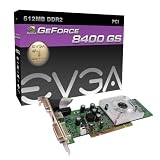
Click Here to see more reviews about: EVGA nVidia e-GeForce 8400 GS 512 MB DDR2 PCI Card (512-P1-N724-LR)
Product Description:
The features of the 8400 GS 512-P1-N724-LR include the GeForce 8400 GS (567MHz clock) chipset, 512MB of DDR2 memory with a 400MHz clock with an effective rate of 800MHz, PCI compatibility, Integrated NVIDIA TV encoder, 3.2GB per second memory bandwidth, NVIDIA unified architecture, Full Microsoft DirectX 9, and OpenGL 2.0 support. This product comes with a one year warranty with a second year free if registered at www.evga.com within 30 days of purchase.
 Get 19% OFF
Want to buy EVGA nVidia e-GeForce 8400 GS 512 MB DDR2 PCI Card (512-P1-N724-LR) at other amazon sites? Click the corresponding icon below:


0 comments:
Post a Comment